
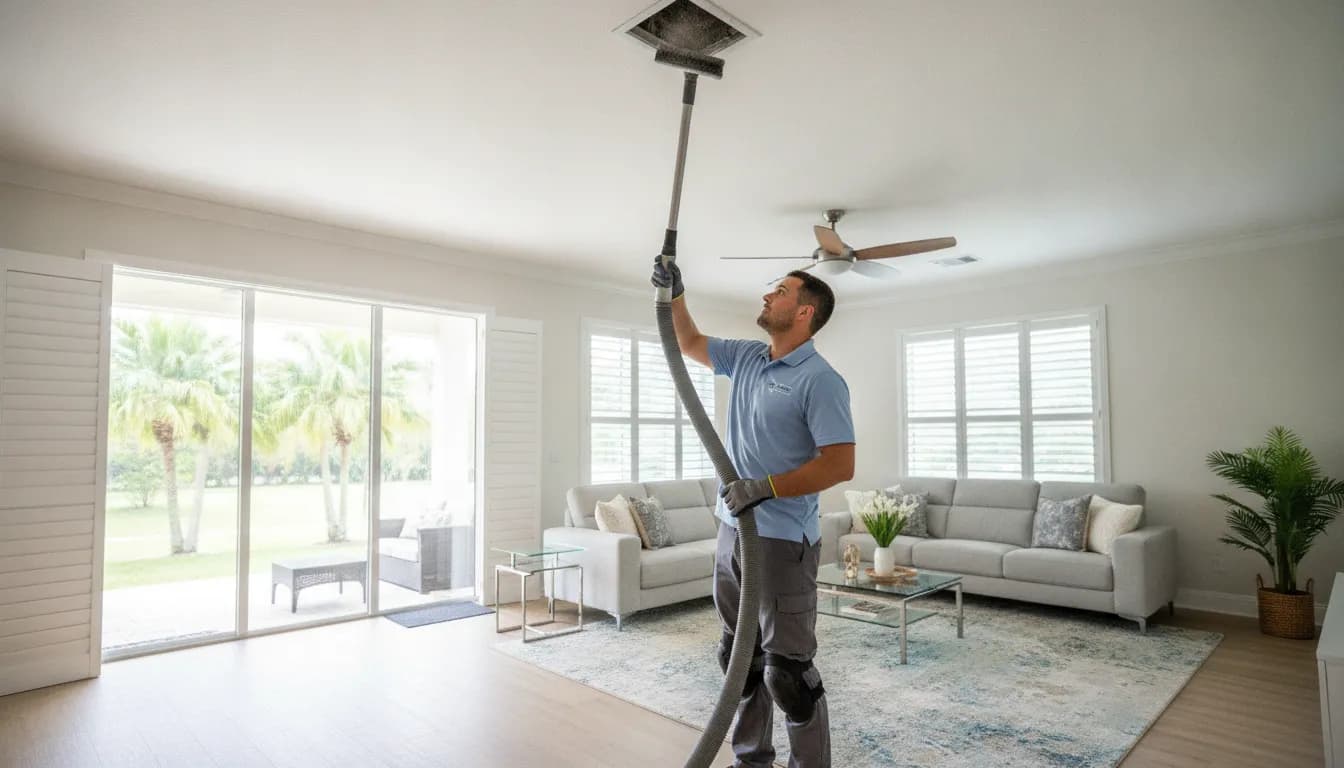
Florida homeowners often wonder whether dusty vents automatically mean their air ducts need professional cleaning. Usually, the answer is more specific: the condition of the ductwork, not ordinary household dust, should guide the decision.
For a typical whole-home service, air duct cleaning cost florida homeowners see is often about $300 to $800, depending on the number of vents, system size, and contamination. Most homes do not need cleaning on a routine schedule, and some do not need it at all.
Cleaning may make sense after a renovation, visible mold on hard-surface ducts, pest activity, or suspected water contamination. Florida humidity can also make mold-related work more involved, but the EPA does not recommend blanket cleaning because it has not been shown to prevent health problems. A careful inspection can help you separate a real duct problem from normal dust and decide whether cleaning, sealing, or another HVAC service is the better investment. For broader planning, see our Florida HVAC cost guide.
Contact Space Coast Cooling for a straightforward evaluation before approving unnecessary work.
How much does air duct cleaning cost in Florida?
For a typical Florida home, air duct cleaning often falls between $300 and $800. The final quote depends on the number of vents, system size, ductwork layout, and how much contamination is present. A small, accessible system with ordinary dust may cost less than a large home with multiple systems or difficult-to-reach components. These are planning ranges, not a substitute for a written estimate based on your HVAC system.
Some companies estimate by square footage of ductwork rather than charging a flat whole-home price. A commonly cited range is $0.15 to $0.30 per square foot. For a 1,500-square-foot home, that approach could produce a rough estimate of $180 to $360. Although the actual ductwork area, vent count, and service scope may differ from the home's floor area. Orlando pricing data has also placed the average near $335, which is useful as a reference point but not a guaranteed local rate.
| Cost driver | What changes the price | Typical planning range |
|---|---|---|
| Home size | Larger homes may have more ductwork, vents, and HVAC zones to service. | About $300-$800 for many whole-home jobs |
| Vent count | More supply and return openings generally require more access and labor. | Often quoted per vent or by project scope |
| Contamination type | Ordinary dust is different from heavy debris, pest contamination, or suspected mold. | Higher than a standard cleaning when remediation is needed |
| Optional services | Dryer vent cleaning, mold-related work, and other add-ons increase the total. | Varies by service and condition |
Florida's humidity can make moisture and mold concerns more relevant, especially when ductwork or HVAC components have ongoing exposure to damp conditions. If mold is suspected, ask what was actually observed and whether the proposed work is cleaning, remediation, or both. Mold-related remediation can cost more than routine dust removal, and the scope should be explained before work begins.
When comparing quotes, request a written breakdown of the components included, access requirements, and any add-ons. A low starting price may not cover the entire system. For broader budgeting context, see our Florida HVAC cost guide. A transparent estimate helps you compare the work itself, not just the headline number.
When do you actually need air duct cleaning?
Air duct cleaning is not an automatic part of every Florida homeowner's maintenance calendar. The U.S. Environmental Protection Agency says there is no blanket recommendation for cleaning residential air ducts, and duct cleaning has not been shown to prevent health problems. The EPA also notes that a light amount of ordinary household dust inside ductwork has no known health risk. Read the EPA's air duct cleaning guidance before treating a sales pitch as a diagnosis.
For most well-maintained Florida homes, cleaning is generally needed no more often than every three to five years, and some homes may go longer without it. Regular filter changes, sound HVAC maintenance, and prompt attention to moisture problems often matter more than scheduling cleaning simply because time has passed. An AC tune-up cost comparison can help you weigh routine system care against a cleaning that may not be necessary.
Situations that justify an inspection
Professional cleaning becomes more reasonable when there is a specific, observable source of contamination, including:
- Substantial visible mold: Mold growth inside hard-surface ducts or on other HVAC components is a reason to investigate and consider cleaning.
- Pests in the ductwork: Rodent, insect, or other pest evidence can leave contaminated material behind and warrants prompt assessment.
- Heavy renovation debris: Cleaning may be appropriate after a major renovation if the HVAC system ran while construction dust was circulating through the home.
Florida's humidity can make moisture-related concerns more important, but a musty smell or dark-looking residue is not proof of mold by itself. The EPA cautions that a substance that looks like mold may require an expert, and sometimes laboratory analysis, to confirm. If a contractor says mold is present, ask to see the affected area and ask what evidence supports the recommendation before approving additional work.
A consultative decision is better than a routine upsell
A trustworthy HVAC professional should inspect the condition of the accessible ductwork and the broader system, then explain whether cleaning addresses an actual problem. If the ducts are intact and show only light dust, declining the service may be the right advice. If there is visible contamination, pest debris, or post-construction buildup, request a written scope that identifies what will be cleaned and why. That approach protects your budget while keeping the focus on a healthier, better-maintained home rather than fear.
What are the signs your air ducts need cleaning?
Air duct cleaning is not a routine requirement for every Florida home. The EPA does not make a blanket recommendation, and light household dust inside ductwork has not been shown to create a health risk. Instead, look for specific evidence of contamination or a condition that could justify an inspection.
Visible debris, pests, or musty odors
Look through accessible supply registers and return vents with a flashlight. A substantial buildup of dust, construction debris, or other material may indicate that the system needs professional attention, particularly if debris is being released into the rooms. Droppings, nesting material, insect remains, or other evidence of rodents and pests inside the ductwork is another strong reason to arrange an assessment. Contaminated material should be addressed rather than left in the system.
Persistent musty odors that appear whenever the HVAC system runs are also worth investigating. An odor does not prove that the ducts are the source, since drain pans, coils, insulation, wall cavities, and other moisture-affected areas can create similar smells. A qualified provider should inspect the broader HVAC system instead of recommending cleaning based on odor alone. These indicators are consistent with the signs summarized by duct-cleaning professionals in Florida.
Visible mold or recent construction dust
Substantial visible mold growth on accessible hard-surface ducts or HVAC components can justify cleaning and further evaluation. However, dark dust or staining is not automatically mold. The EPA notes that a substance that looks like mold may require expert confirmation, and many parts of an HVAC system cannot be inspected without gaining access. Before agreeing to cleaning or remediation, ask the provider to show you the visible mold they identified and explain where it is located. If they cannot show you the alleged growth, ask for a clearer inspection and written explanation before authorizing work. See the EPA's guidance on duct cleaning and mold for the relevant cautions.
Major remodeling is another reasonable trigger for an inspection, especially if the HVAC system operated while sanding, cutting, or removing materials created heavy construction dust. Cleaning may be appropriate when that debris reached the ductwork, but the decision should be based on what is actually present rather than on the renovation alone.
Unexplained allergy-like symptoms
Recurring allergy-like symptoms may prompt questions about indoor air quality, but they are not proof that dirty ducts are responsible. First address other common sources, including inadequate filtration, visible moisture or mold elsewhere, outdoor air entry, pets, smoke, and cleaning products. If symptoms continue after those sources have been evaluated, a professional HVAC and indoor-air-quality assessment may help determine whether duct contamination is relevant. This cautious approach is more useful than assuming that cleaning will prevent health problems, which the EPA says has not been demonstrated.
How to tell a legitimate duct cleaning company from a scam
Choosing a duct cleaner should not come down to the lowest advertised price. A legitimate provider explains what your system needs, what the crew will do, and what you will pay before work begins. A questionable provider may use a very low introductory offer to get inside your home, then create urgency around problems you cannot easily verify.
Be cautious with extremely low whole-home offers
A $99 "whole-home" offer deserves careful questions. These promotions can function as foot-in-the-door pricing: once a technician arrives. The company may recommend multiple paid add-ons or claim that basic cleaning does not cover most of your system. The concern is not that every low-price advertisement is automatically fraudulent, but that the advertised scope may be incomplete. Ask what the offer includes, how many supply and return components are covered, and whether the price changes after an inspection. This context matters when comparing local HVAC repair or indoor-air-quality providers.
Require a detailed written estimate
Before approving work, request an estimate that identifies the components to be cleaned and states the total cost. It should be clear whether the price covers supply ducts, return ducts, registers, grilles, the air handler, blower, and accessible coil areas, or only individual vents. The estimate should also identify separate charges for difficult access, contamination, mold-related work, or optional services. A provider that will not put the scope and price in writing makes it difficult to compare estimates or challenge an unexpected bill.
Check standards and question chemical upsells
NADCA certification can be a useful professional-standards signal when comparing companies. It does not replace sensible questions, but it gives you another way to evaluate a provider's training and procedures. Also be cautious when a company routinely recommends chemical biocides or antimicrobial treatments as part of every cleaning. The EPA describes duct biocide use as an unresolved issue, and these products should have a specific, explained purpose rather than being an automatic upgrade. Ask what problem the treatment addresses, why cleaning alone is insufficient, and what product will be used. EPA guidance on duct cleaning can help you evaluate the explanation.
Look at how the crew protects your home
Professional work includes containment and equipment appropriate for the job. Expect drop cloths or other protection for floors, furniture, and nearby finishes. The vacuum system should use high-quality HEPA filtration or exhaust outside the home rather than simply blowing collected dust into the living space. If the provider cannot explain how dust will be contained, what equipment will be used, or which parts of the system will be accessed, pause before signing. A transparent inspection and written scope are better indicators of value than a dramatic discount.
What does a professional air duct cleaning include?
A professional cleaning should be a controlled HVAC service, not simply a vacuum hose pushed into one vent. Before work begins, the technician should explain which accessible components will be cleaned, how the equipment will be connected, and what condition the system is in. A comprehensive check may include the blower motor and evaporator coil. Not just the visible duct openings, so the provider can determine whether cleaning is appropriate for the system. A full-system assessment can help separate a ductwork problem from an issue that needs HVAC repair or maintenance.
Protecting the home and controlling the debris
Technicians should use drop cloths or similar protection around work areas, furniture, and flooring. The vacuum equipment should use high-efficiency HEPA filtration or exhaust outside the home. That setup helps capture loosened dust instead of allowing it to settle back into living spaces. These safeguards are basic signs of a careful process, especially when equipment must be moved through a finished Florida home. The provider should also use appropriate access tools to agitate buildup so the vacuum can remove it from the duct surfaces, rather than cleaning only the registers.
Maintaining proper airflow during the work
Return air vents are part of the HVAC system's airflow path and should not be blocked during cleaning. Blocking them can jeopardize system airflow and pressure. Ask how the contractor will connect its equipment without interfering with essential system components. And be cautious if the proposed setup requires sealing or obstructing returns in a way that could strain the system. EPA guidance also supports asking practical questions about the method and components included before authorizing work.
Sealing connections and checking the result
After cleaning, the technician should inspect accessible duct interiors. A thorough result should leave those surfaces free of visible dust and debris. The contractor should also check duct connections and properly tape or seal gaps where appropriate. Unsealed connections can allow dust and contaminants from attics or crawl spaces to enter the system again, reducing the value of the cleaning. Finally, ask what was inspected, what was inaccessible, and whether the technician found damage or moisture that needs separate attention. A clear before-and-after explanation is more useful than a generic claim that the entire system is clean.
Air duct cleaning vs air duct replacement: what is the difference?
Air duct cleaning and air duct replacement solve different problems. Cleaning removes dust, debris, and other contamination from ductwork that is still structurally sound. It can improve the condition of the system's interior, but it does not rebuild damaged materials or correct major air leaks.
Replacement may be appropriate when the ductwork itself is compromised. Examples include sections that are leaking badly, collapsing, crushed, disconnected, or made from flexible duct material that has deteriorated. Water damage, pest damage, and severe deterioration can also make replacement a more practical long-term choice than repeatedly cleaning the same failing components.
When cleaning is the right option
If the ducts are intact and the main issue is accumulated debris, professional cleaning may address the problem without replacing the system. A technician should inspect accessible duct sections and related HVAC components before recommending work. The goal is to identify what is actually contaminated, not to treat every home as if it needs a major project.
Cleaning is not a repair for leaks. If gaps at duct connections allow dust from an attic or crawl space into the system, those connections should be properly taped or sealed. The EPA explains that appropriate sealing can help prevent dust and dirt from escaping or entering through ductwork, but the sealant must suit the duct material and be applied correctly.
When replacement deserves a closer look
Replacement is a much larger investment and should be treated as a separate decision from the cost of air duct cleaning. Cleaning a collapsed or badly deteriorated duct may remove surface debris temporarily, but it cannot restore the duct's shape, strength, or airtight performance. Leaking ducts can also waste conditioned air, so replacing severely damaged sections may be more effective than paying for repeated cleanings.
Ask for a clear explanation of which sections are damaged, why repair or sealing will not solve the issue, and whether partial replacement is possible. For context on the broader financial decision, review our HVAC replacement cost guide. A professional recommendation should distinguish cleaning, sealing, repair, and replacement instead of combining them into one vague proposal.
Schedule a free air duct and HVAC consultation with Space Coast Cooling to confirm what your ductwork actually needs before you commit to cleaning, sealing, or replacement.
Frequently Asked Questions
What is the average air duct cleaning cost in Florida?
A whole-home cleaning commonly falls around $300 to $800, although the final quote depends on the system, number of vents, duct layout, and contamination level. Ask for a written estimate that clearly lists which components will be cleaned.
Is air duct cleaning worth the money in Florida?
It can be worthwhile when you have substantial visible mold, pest evidence, heavy debris after a renovation, or suspected contamination. Routine cleaning is not automatically necessary. The EPA does not make a blanket recommendation, and duct cleaning has not been shown to prevent health problems.
How often should you have your air ducts cleaned in Florida?
There is no universal schedule. Many Florida homes may go three to five years between cleanings, while others may not need one unless a specific problem appears. Regular filter changes and HVAC maintenance are usually the better first steps for controlling dust.
Does mold growth affect air duct cleaning costs?
Yes. Mold-related work can require additional inspection, containment, remediation, or treatment beyond ordinary dust removal. Do not rely on a visual claim alone: the EPA recommends expert confirmation, and you should ask the provider to show you the suspected growth before approving extra services.
Why do some companies advertise whole-home duct cleaning for $99?
A $99 offer may cover only a limited portion of the system and can lead to on-site upsells. Before scheduling, confirm whether the quote includes supply and return ducts, the air handler, access work, cleanup, and any added fees. A detailed written estimate is more useful than the lowest advertised price.
Schedule a free air duct consultation
If you are unsure whether cleaning is appropriate for your Brevard County home. A professional review can help you choose the right next step without paying for unnecessary work. To discuss your system and concerns, schedule a free air duct and HVAC consultation with Space Coast Cooling and Plumbing.